Lateral Reading
Lateral Reading
The move that sets professional fact-checkers apart from everyone else. Don't judge a source from the inside.
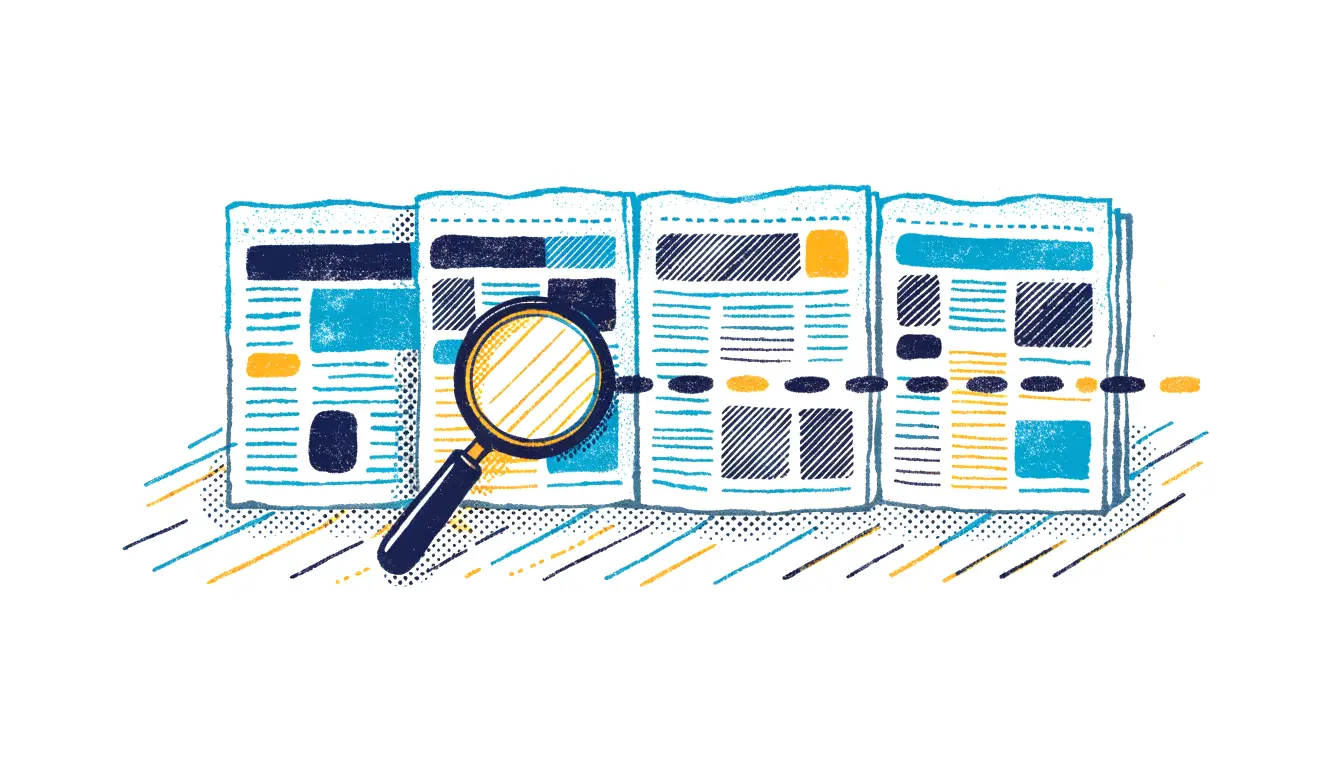
“Lateral reading” is a term proposed by Sam Wineburg and his team at the Stanford History Education Group, as part of the Civic Online Reasoning (COR) program. It describes a behavior observed among professional fact-checkers and largely absent from the rest of the public.
Whereas historians and students stayed put on the source they were evaluating, professional fact-checkers raced off the page, opening multiple tabs to verify the source's reputation before even reading its content.
Vertical reading vs. lateral reading#
The traditional approach is vertical: you read a page from top to bottom, looking for internal clues of reliability (layout, tone, legal notices, footnotes). This approach fails systematically against professional disinformation sites, which imitate the look of legitimate media perfectly.
The lateral approach means leaving the page as soon as you've opened it, searching for the name of the outlet or the author in another tab, and seeing how independent third parties talk about it. It's a matter of distributed reputation, not local presentation.
The experiment that changed everything#
In 2017, Wineburg's team gave the same test to three groups: 10 accomplished historians, 10 Stanford students and 10 professional fact-checkers. Each participant had to evaluate the credibility of two political advocacy websites, one respectable-looking and the other clearly partisan.
The fact-checkers identified both biases in under a minute, systematically searching for the site's name before reading its content. The historians and students took ten times longer on average and were frequently fooled by the layout of the disguised partisan site.
Why it's so hard to do on your own#
Lateral reading sounds simple to describe. It is surprisingly hard to apply in practice, because the human brain is wired to evaluate an object by how it presents itself at first sight. Leaving a page to look elsewhere takes a deliberate effort that works against cognitive inertia.
That's exactly why a tool is better than a person at making this move systematic. Factare can't “be lazy”: every claim mechanically triggers several lateral searches, regardless of the model's initial conviction.
References
Sources of the method
- Wineburg, S. and McGrew, S. (2019). Lateral Reading and the Nature of Expertise: Reading Less and Learning More When Evaluating Digital Information. Teachers College Record, 121(11), 1-40.
- McGrew, S. et al. (2018). Can Students Evaluate Online Sources? Learning From Assessments of Civic Online Reasoning. Theory & Research in Social Education, 46(2), 165-193.
- Wineburg, S. et al. (2022). Lateral reading on the open Internet: A district-wide field study in high school government classes. Journal of Educational Psychology, 114(5), 893-909.